


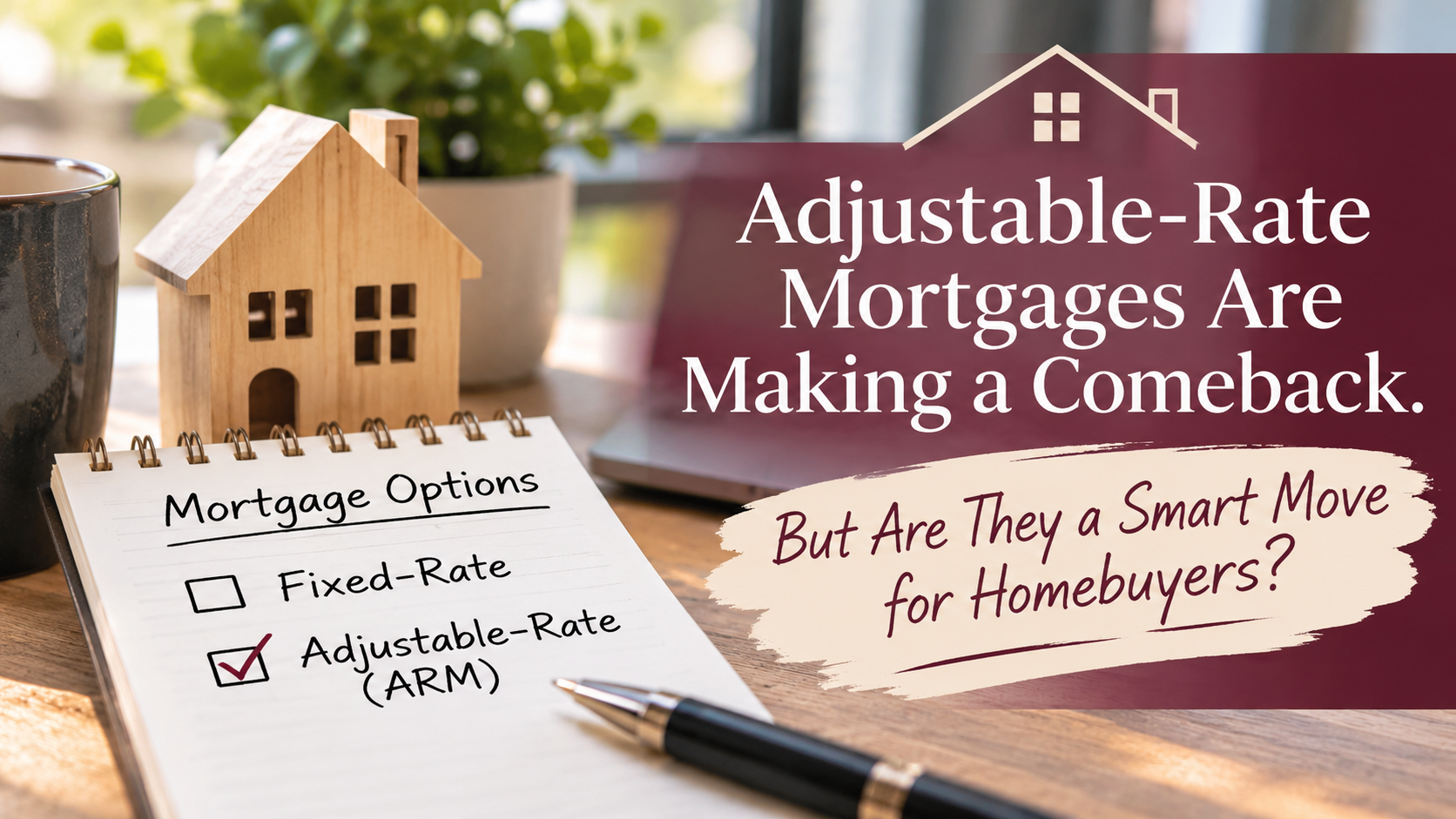
If you've been keeping an eye on mortgage rates lately, you already know that affordability continues to be one of the biggest challenges for homebuyers.
Between home prices, interest rates, property taxes, and insurance, buyers are looking for just about any opportunity to make their monthly payments more manageable.
And apparently, more of them are taking another look at adjustable-rate mortgages.
According to a November 4, 2026, report from Homes.com, adjustable-rate mortgages (ARMs) accounted for 11.4% of all mortgage applications, their highest share in 14 months.
That's a pretty significant shift, especially considering that many buyers have traditionally preferred the predictability of a 30-year fixed-rate mortgage.
So, what's driving the renewed interest? And more importantly, should you consider an adjustable-rate mortgage if you're planning to buy a home in the Denver Metro area?
Let's talk about it.
First, What Exactly Is an Adjustable-Rate Mortgage?
Most people are familiar with a traditional fixed-rate mortgage. You lock in your interest rate when you purchase your home, and that rate stays the same for the life of the loan.
An adjustable-rate mortgage works a little differently.
With an ARM, your interest rate is fixed for an initial period, typically five, seven, or ten years. After that, the rate can adjust periodically based on market conditions and the terms of your loan.
For example, with a 7/1 ARM, your interest rate stays the same for the first seven years and then can change annually.
The biggest attraction? ARMs often come with lower initial interest rates than traditional fixed-rate mortgages.
And when affordability is already stretched, even a modest difference in interest rates can make a noticeable difference in your monthly payment.
Why Are More Buyers Considering ARMs Right Now?
Recent mortgage application data tells us something interesting about buyer behavior.
While adjustable-rate mortgage applications are gaining market share, overall mortgage activity actually declined 1.2% during the same reporting week.
Purchase applications dropped 2%, and refinancing activity remained relatively flat.
In other words, buyers aren't necessarily rushing back into the market. Instead, some of the buyers who are moving forward appear to be exploring different financing options to make homeownership work.
And I think that's an important distinction.
We're seeing buyers become increasingly thoughtful about what they can comfortably afford, rather than simply focusing on the maximum amount they're approved to borrow.
Could an ARM Make Sense for Denver Metro Buyers?
Potentially. But it really depends on your circumstances.
Let's say you're purchasing a home in Brighton, Thornton, Commerce City, or another Denver Metro community.
You find a home you love, but the monthly payment with a traditional fixed-rate mortgage is pushing the upper end of your comfort zone.
Your lender presents an adjustable-rate mortgage with a lower introductory interest rate.
That could make the initial payment more attractive.
But here's where I encourage buyers to look beyond the immediate savings.
An ARM might be worth exploring if you understand the potential future payment changes, have financial flexibility, and have a realistic plan for how long you expect to own the home.
For example, someone who expects to relocate within several years may evaluate an ARM differently than someone purchasing their forever home.
However, plans can change.
You might intend to sell or refinance before your interest rate adjusts, but there's no guarantee that mortgage rates will be lower when that time comes, or that refinancing will be financially beneficial or even available.
That's why I would never recommend choosing a mortgage based solely on the assumption that you can refinance later.
The Part About ARMs That Buyers Really Need to Understand
The initial interest rate is only part of the equation.
Before choosing an adjustable-rate mortgage, I would encourage you to have your lender walk you through a few important questions:
How long is the introductory fixed-rate period?
How often can the interest rate change afterward?
How much can the rate increase at the first adjustment and over the life of the loan?
What would your monthly payment look like if the rate increases?
How does the total cost compare with a fixed-rate mortgage?
Are there any prepayment penalties or other loan terms you should understand?
And perhaps the most important question of all:
Would you still be comfortable with the payment if your interest rate increased?
If the answer is no, that's something you need to consider very seriously.
Buying a Home on One Income? This Matters Even More.
One of the things I'm particularly passionate about is helping women who are purchasing homes independently.
And when you're buying on a single income, I believe it's especially important to make financing decisions that support your long-term financial security.
That doesn't mean an adjustable-rate mortgage is automatically a bad option.
It means understanding the risks, protecting your financial flexibility, and making sure your home fits comfortably into the life you're building.
I always want my buyers to remember that qualifying for a particular mortgage payment and feeling comfortable making that payment are two very different things.
You still want room in your budget for savings, travel, unexpected repairs, and everything else that's important to you.
Homeownership should add to your financial stability, not leave you constantly worried about your next payment.
What About Mortgage Rates Going Forward?
This is where things get a little unpredictable.
The Homes.com report noted that mortgage rates had recently eased to their lowest weekly averages since late September, although the 30-year fixed-rate mortgage remained above 7% in the data cited.
And even small changes in economic reports, employment numbers, and investor expectations can influence where mortgage rates go next.
The Federal Reserve also plays a role in broader financial conditions, but it doesn't directly set mortgage rates.
So, while everyone would love to know exactly where rates will be six months or a year from now, nobody can guarantee that answer.
That's why I encourage buyers to focus on what makes financial sense for them today, while also considering what could happen in the future.
My Advice? Don't Rule Out Your Options, but Understand Them.
I don't believe there's one mortgage product that's right for every buyer.
A 30-year fixed-rate mortgage may offer the predictability and peace of mind that one person needs.
An adjustable-rate mortgage might be worth considering for someone else, depending on their financial situation, risk tolerance, and long-term plans.
The key is having the right information before making that decision.
If you're thinking about buying a home in the Denver Metro area, I would encourage you to speak with a knowledgeable lender who can show you side-by-side comparisons of different loan programs.
Look at the initial payments, potential future payments, closing costs, and long-term implications.
And don't be afraid to ask questions.
Buying a home is a big financial decision, and you deserve to feel confident about the one you're making.
Thinking About Buying in the Denver Metro Area?
Whether you're purchasing your first home, buying independently, or considering a move, I'd love to help you explore your options.
I work with buyers throughout Brighton, Commerce City, Thornton, Westminster, and the surrounding Denver Metro communities.
Let's talk about what you're looking for, what you're comfortable spending, and how we can build a homebuying strategy that makes sense for you.
Mandy Lacey
The Ignite Key Team | Key Team Real Estate
Source: Homes.com News, November 4, 2026, "ARM Demand Hits 14-Month High as Borrowers Hunt for Lower Rates," reporting Mortgage Bankers Association mortgage application data.
Mortgage programs, rates, and eligibility vary by lender and borrower. Consult a licensed mortgage professional for financing advice.
Check out this article next