

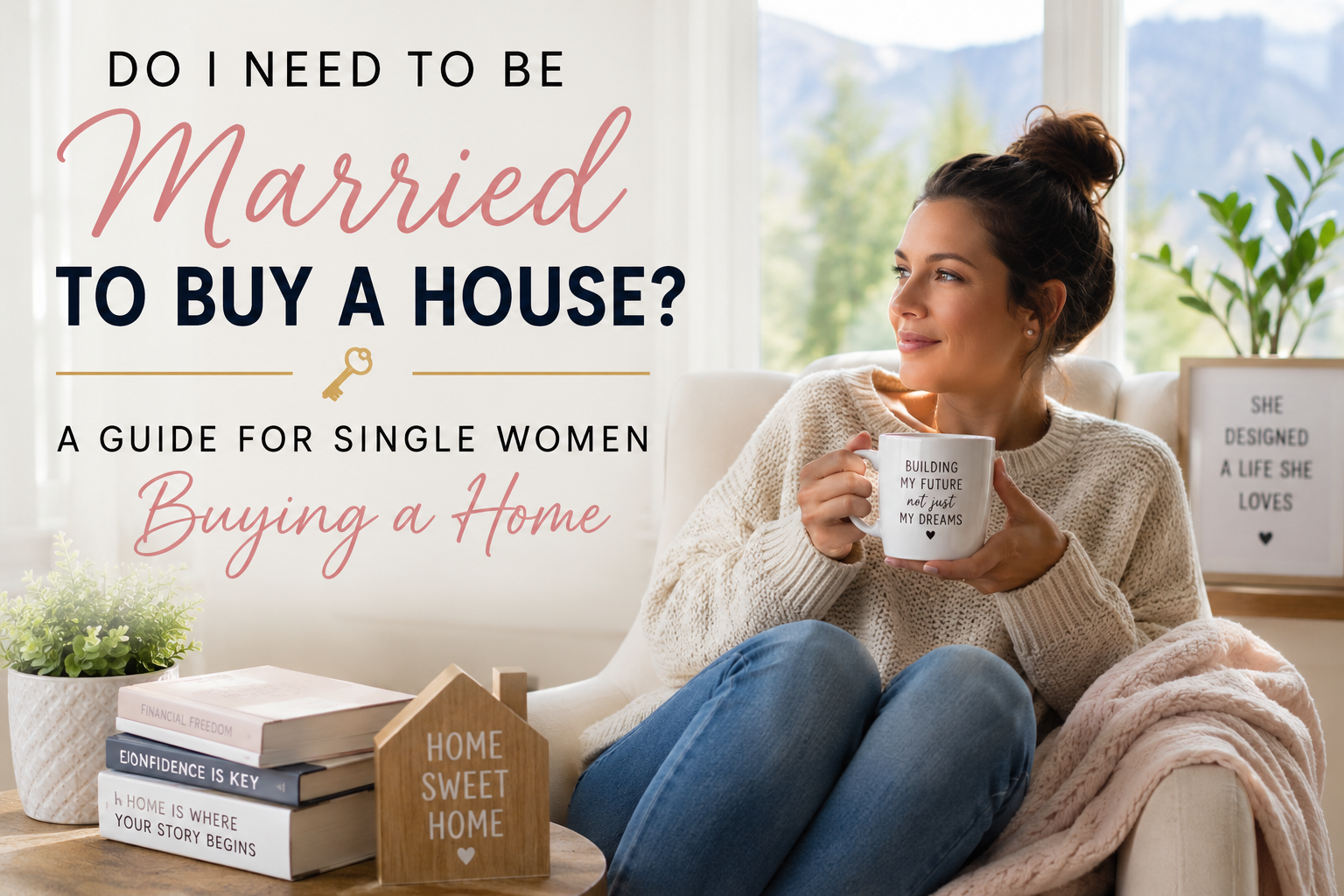
For generations, women were taught a pretty predictable order for how life was supposed to go.
Build a career. Meet someone. Get married. Buy a house. Build a life together.
But more and more women are realizing something important:
You don't have to wait for a relationship to start building the life you want.
And that includes buying a home.
If you're a single woman who has wondered whether you should wait until you're married, have a partner, or have two incomes before buying a house, here's what I want you to know:
Being married is not a prerequisite for homeownership.
In fact, single women are already a significant force in today's housing market.
Single women aren't waiting to buy homes
According to the National Association of REALTORS®' latest Profile of Home Buyers and Sellers, single women account for 21% of all home buyers in the United States. Single men account for just 9%.
The difference is even more noticeable among first-time buyers.
One in four first-time home buyers, 25%, is a single woman, compared with 10% who are single men.
And women are accomplishing this despite having less income on average.
The median household income for a single female buyer is approximately $76,400, compared with $79,300 for single male buyers.
There are now more than 20 million single women homeowners in the United States, and approximately 51% of single women own their homes.
That matters because homeownership is no longer something women are simply doing after marriage.
They're doing it on their own terms.
We've come a very long way
There's another statistic I think every woman should know.
It wasn't until 1974 that federal protections made it unlawful for creditors to discriminate based on sex or marital status. Before those protections, women could routinely face requirements such as having a husband or male relative cosign for credit.
Think about how recent that is.
In 1981, when the National Association of REALTORS® began tracking this data, single women represented just 11% of home buyers.
Today, they represent 21%.
That shift isn't just interesting housing data.
It represents generations of women gaining greater financial independence and deciding that their plans don't have to depend on their relationship status.
But can I qualify for a mortgage on one income?
Possibly.
The question isn't really whether you're single.
The better question is:
What can you comfortably afford with your income, debts, savings and lifestyle?
When you're purchasing by yourself, you don't have a second income to include in the loan qualification. That can affect your buying power.
But needing to buy within a certain budget is very different from being unable to buy.
A lender will generally look at factors including:
- Income
- Employment history
- Credit
- Existing monthly debts
- Available funds for your down payment and closing costs
- The type of mortgage you're using
The goal shouldn't be to find out the maximum amount someone will lend you.
I want my clients to understand what owning the home will actually cost and choose a payment that allows them to continue enjoying the rest of their lives.
Because becoming a homeowner shouldn't mean becoming house poor.
Do I need 20% down if I'm buying by myself?
No.
This is one of the home-buying myths I would love to permanently retire.
There are mortgage programs that allow qualified buyers to purchase with considerably less than 20% down. The exact options available to you depend on your finances, the property, the loan program and current lending guidelines.
Even in today's challenging market, first-time buyers aren't universally putting 20% down. NAR's latest data shows the median down payment among first-time buyers was 10%.
That doesn't mean 10% is what you need.
It means you shouldn't decide homeownership isn't possible because you've been working toward an arbitrary 20% number.
Find out what your actual options are first.
Is buying alone riskier?
Buying on one income does require you to think differently about certain things.
There's no second income automatically available if something changes financially. You're also the person responsible when the furnace quits, the water heater needs replacing or another unexpected expense appears.
That's why I think single women should consider more than simply:
"Can I qualify?"
We should also be asking:
"Will I feel financially comfortable after I buy?"
That conversation may include your emergency savings, expected maintenance costs, HOA dues, property taxes, insurance and how much money you want left every month for travel, dinners, hobbies, retirement savings and everything else that makes up your life.
Your house should support the life you're building.
It shouldn't consume it.
Should I wait until I'm in a relationship?
This is where I have a different perspective.
If waiting makes sense for you financially, professionally or personally, then wait.
But I don't believe you should automatically postpone homeownership because someday you might meet someone, get married and buy a home together.
You can make a decision based on the life you have today.
If your life changes later, your housing can change with it.
You can sell.
You may eventually turn the property into a rental.
You may keep it.
You may meet someone who already owns a home.
You may eventually purchase another home together.
There are plenty of possibilities.
What I don't want women doing is putting their own goals on hold indefinitely because they're waiting for a hypothetical future relationship to determine what their life should look like.
What if I'm not ready yet?
Then don't buy yet.
Seriously.
My message isn't that every single woman should own a home.
It's that every single woman deserves to understand whether she can.
There is an important difference.
If homeownership is something you want eventually, you can start building toward it long before you're ready to start touring houses.
That might mean:
- Understanding your credit.
- Talking with a lender about what you'd qualify for today.
- Determining a monthly housing payment that actually feels comfortable.
- Learning about down-payment and financing options.
- Building your savings and emergency fund.
- Understanding what homes realistically cost in the communities where you'd want to live.
- Creating a 6-, 12-, or even 24-month plan.
You don't have to be ready to buy a house tomorrow to start getting ready today.
The question I want single women asking
Not:
"Should I wait until I'm married?"
Instead, ask:
"Would buying a home make sense for the life I'm building right now?"
Those are two very different questions.
Single women are already proving that marriage and homeownership don't have to arrive as a package deal. They represent more than one in five home buyers today, and among first-time buyers, they're purchasing at more than twice the rate of single men.
You can build a career.
You can build financial security.
You can build community.
You can build a home.
And if the right relationship becomes part of that life someday, wonderful.
But you don't have to wait for someone else to start building it.
About Mandy Lacey
I'm Mandy Lacey, a Colorado real estate agent and Team Lead serving the Denver metro area, with a particular focus on helping women understand their options around homeownership.
I'm also a single woman.
I understand what it means to build a full life independently, make major financial decisions on your own and reject the idea that certain milestones have to happen in a particular order.
My goal isn't to convince every woman that she needs to buy a house.
It's to make sure women have the information, resources and confidence to decide what's right for themselves.
If you're wondering whether buying a home on your own is realistic, start with the numbers. You may be much closer than you think.
Sources
National Association of REALTORS®, 2025 Profile of Home Buyers and Sellers and 2026 housing-market research on single female buyers
Check out this article next