


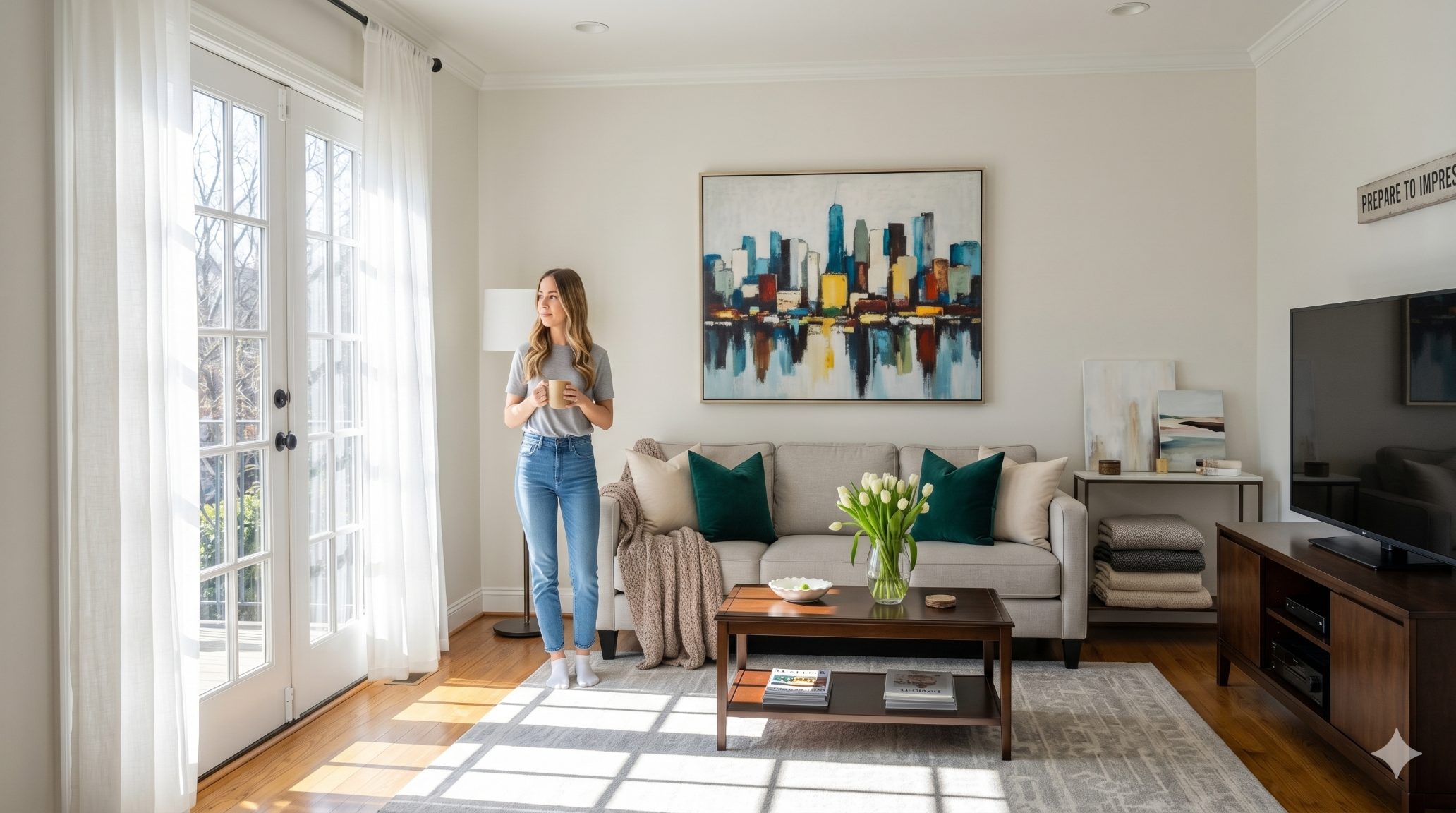
Why staging matters more than ever in today's Denver Metro market, and what it actually looks like in practice.
I was wrapping up one of my recent buyer webinars when an attendee said something that stopped me cold.
She had been searching online, fallen in love with a home based on the photos, driven out to see it, and walked through the front door to find an empty house. No furniture. No warmth. No feeling at all. What she had seen in the listing photos was virtual staging, digitally added furniture that existed only on a screen.
"It just didn't feel the same," she said. "I left disappointed."
I've heard versions of that story more times than I can count. And it points to something every seller needs to understand before they list: the way your home feels when a buyer walks through the door is just as important as how it looks online. Sometimes more so.
This is a post about staging. Not the fluffy version, but the real, practical, what-it-actually-means version, along with why in today's Denver Metro market it may be the single highest-return decision you make before you list.
The Denver Market Has Changed. Staging Has Not.
In 2021 and 2022, sellers could list almost anything and buyers would fight over it. Those days are gone.
Active inventory across the Denver Metro currently sits at over 13,000 listings, the highest level in over a decade. Average days on market have stretched to 56 days. Nearly 60% of transactions now include seller concessions. Buyers have choices, and when buyers have choices, they gravitate toward the homes that show the best.
The unstaged home gets scrolled past. The staged home gets showings.
According to the National Association of REALTORS®, 83% of buyers' agents say staging makes it easier for a buyer to visualize the property as their future home. Nearly half of sellers' agents report fewer days on market for staged homes, with research showing staged homes average 23 days on market compared to 47 days for unstaged properties. And on price? Staged homes sell for anywhere from 1 to 10% more than their unstaged counterparts, with an average staging investment of around $1,500 to $1,800.
On a $580,000 home, a 6% increase is nearly $35,000. The math is not subtle.
Virtual Staging: Better Than Nothing, But Not Without a Cost
Let's talk about the digital shortcut, because it's become very common and it deserves an honest conversation.
Virtual staging looks beautiful online. It increases click-through rates, gets buyers in the door, and costs a fraction of physical staging. I'm not against it.
But here's what it cannot do: it cannot create a feeling.
When a buyer walks into a home that was fully furnished in the photos and completely empty in person, something shifts. The trust erodes a little. The excitement they brought through the door walks out with them. That's not a theory. That's what buyers tell me, and it's what that webinar attendee described so perfectly.
Virtual staging is a better option than bare walls and empty rooms in photos. But it sets a buyer up for a gap between expectation and reality the moment they arrive. Real staging closes that gap.
What Real Staging Actually Looks Like
Here's where I want to get specific, because staging is not a single thing. It looks different depending on your situation.
If you're living in the home:
The goal is to help a buyer picture their life there, not yours. That means removing roughly half the furniture so rooms feel open and breathable rather than crowded. It means packing away personal photographs, specific decor, collections, and anything that signals one particular taste or lifestyle. It means going through closets and removing what you don't need, which also happens to be a great head start on your move.
This isn't a judgment of how you live. It's a presentation decision, and it makes a measurable difference in how buyers experience the space.
If the home is empty or nearly empty:
Carefully selected furniture and accessories, pieces that fit the scale of each room without overpowering it, transform a cold, echoey space into something that actually feels like a home. An empty living room tells a buyer nothing. A thoughtfully staged one tells them exactly how they could live there.
This is where the virtual vs. real staging comparison is most stark. Empty homes with virtual photos are one of the most common sources of buyer disappointment I see. If the home is vacant, physical staging is worth every dollar.
The Details That Build Buyer Trust
Beyond furniture and layout, there's a category of staging that doesn't get talked about enough: the small things that tell a buyer how well a home was cared for.
Deep clean everything. And I mean everything. Baseboards. Grout lines. Window tracks. The inside of the microwave. Buyers notice. Clean signals care, and care signals value.
Replace dated hardware and faucets. This is one of the highest-return updates you can make before listing. New cabinet pulls, a modern faucet, updated light switch covers. Small costs, big visual impact.
Fix the small maintenance items. That sticky door latch. The cabinet hinge that doesn't quite close. The cracked outlet cover in the hallway. These things will come up in a buyer's inspection anyway, and when they do, they raise questions about what else might have been deferred. Addressing them before you list removes that doubt entirely.
Every small detail adds up to a feeling. And that feeling is: this home was loved. When a buyer feels that, they trust the price.
Yes, Including That Fuchsia Wall.
One of the most common conversations I have with sellers is about personalization, specifically how much of it needs to come down before we list.
The answer is: most of it.
Your bold paint colors, your specific art, your family photos, your carefully curated decor — these are expressions of you, and they're wonderful. They are also, in a listing context, a distraction. A buyer standing in front of a fuchsia accent wall is thinking about how much they dislike it, not about how much they want to live there.
I bring in my painter. We neutralize. Warm, soft, current tones that feel neither blank nor distracting. Tones that give buyers just enough of a canvas to picture their own style, while still feeling like a home they want to walk into.
The goal is a space that feels genuinely inviting to a wide range of buyers: warm enough to feel like home, neutral enough to feel like theirs.
Why This Matters More Right Now
In a market where your home may sit for weeks before receiving an offer, where buyers are requesting concessions and have multiple options at every price point, your first impression is not just important. It may be the only impression you get.
A home that shows beautifully and feels move-in ready from the moment a buyer walks in does something that no price reduction can replicate: it makes a buyer feel confident. Confident in the home, confident in the price, confident in saying yes.
I have rarely, if ever, seen a seller invest in the right preparation before listing and not see it reflected in buyer interest and offers, even in a buyer's market. The sellers who skip it to save time or money almost always wish they hadn't.
How I Work With Sellers on This
Every seller I work with gets a pre-listing consultation before we talk about price or timeline. We walk through the home together, room by room, and I tell you exactly what I see through a buyer's eyes, not what you want to hear, but what will make the difference.
Some of it is simple: rearrange, pack away, clean thoroughly. Some of it involves my painter, my handyman, or a stager I trust. None of it is guesswork, and all of it is calibrated to your specific home and price point.
The goal is never to spend for the sake of spending. It's to position your home at its absolute best so that when the right buyer walks through the door, they already feel at home.
Don't leave money on the table. The sellers who take the time to do this right are the ones who walk away knowing they got everything their home had to give.
I also have exceptional lender partners who work with move-up buyers on both sides of the transaction, helping structure the financing so the move makes sense from every angle. Together, we'll figure it out.
Ready to find out what your home could sell for with the right preparation? Start the conversation at start.carliplummer.com
Carli Plummer is a buyer's and seller's agent serving the Denver Metro Area, including Thornton, Northglenn, Brighton, Commerce City, and surrounding communities. She works with sellers who want to position their home at its best, and buyers who want to find theirs.
Check out this article next